Fame for Hierakonpolis
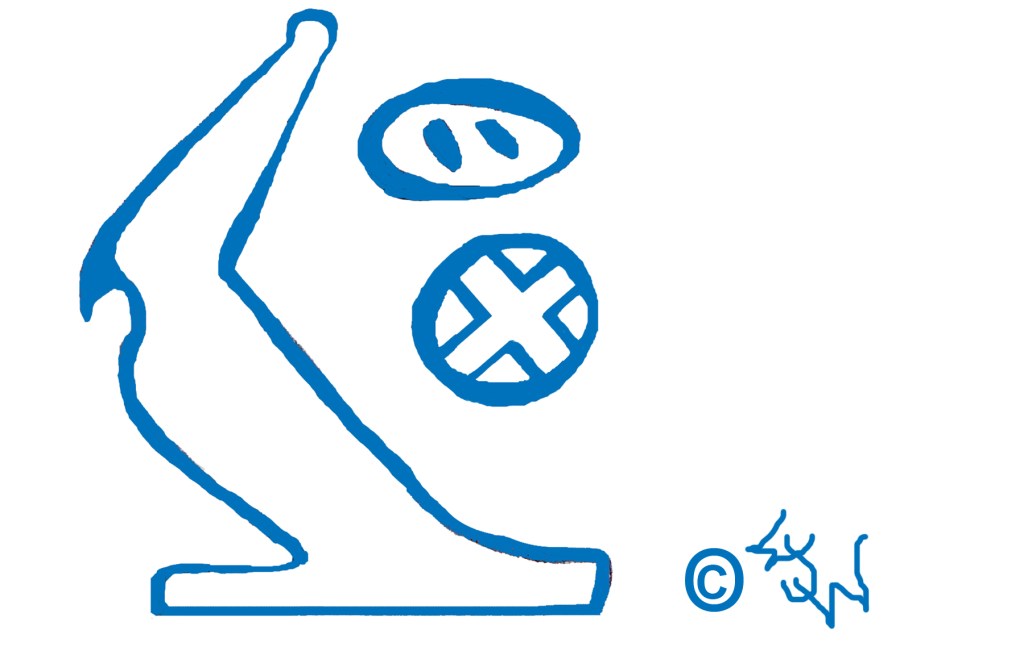
Ancient Nekhen in hieroglyphs (the two circles, one with two lines is Nekhen and the X in the second circle is place – in image above) and in ancient Greek it was Hierakonpolis: city – polis of the hawk which is Ἰέραξ (pronounced Hierax). The third name for this site in the farmland is ,Kom el Ahmar نخة ثم شاةشق for the red mound of pottery.
Special finds of early named kings found by Quibell and Green, first excavations 1897-99, awarded international fame for Hierakonpolis, the site in the Nile farmland.

Narmer on the front of the palette, Cairo Museum website
The ‘Great’ ceremonial palette of Narmer
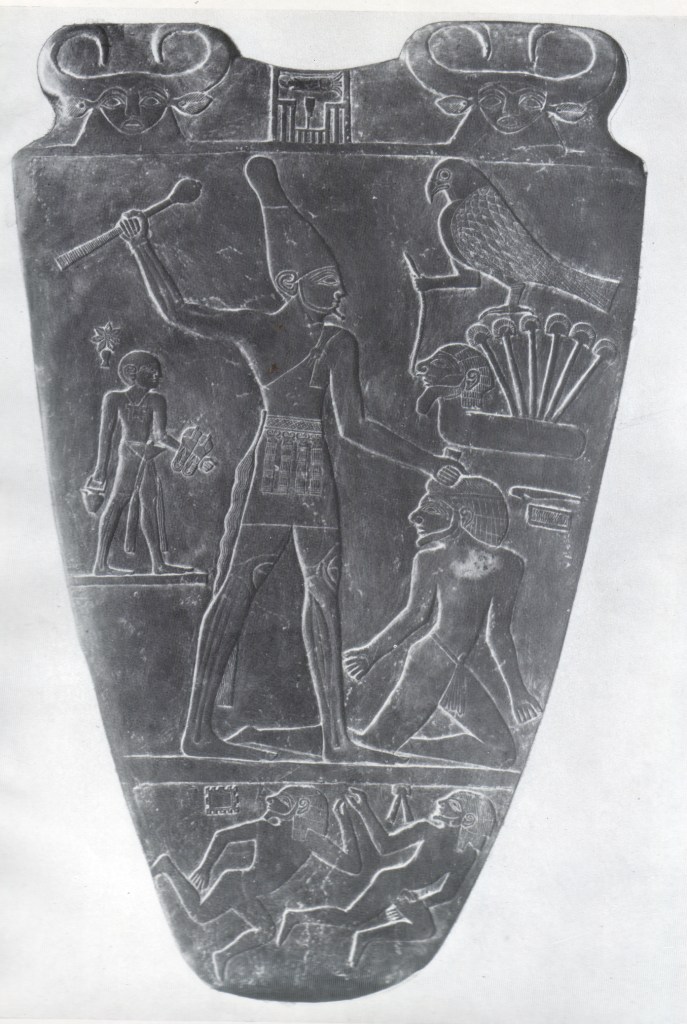
Best of the early photographs with clarity of the fine details in the Narmer Palette, (from Petrie, Ceremonial Slate Palettes, 1953 plate J). H: 63 cm.
The ‘great’ ceremonial palette of Narmer and monuments of early possible rulers were announced by Sir. W. Flinders Petrie in 1898. He concluded that ‘no more important discovery has ever been made in Egypt,’ mostly for prehistory and early kings. Many respects Petrie foretold the importance of this site to early kings and many later scholars credit Narmer as the first king, c. 3200 -3050 BCE (depending on the possible date assigned to Dynasty I).
- (Petrie, “Progress of Egyptology,” Archaeological Reports 1897-98 of the Egypt Exploration Society, p.7).
His victory image has a long tradition with the later kings of Egypt often monumental on temple pylons (front gates) and exterior walls. Discussion has suggested precursors but the clarity and focus of the preserved Palette of Narmer continues to award this item as the early successful royal formula.
All importance of victory is foremost with Narmer on both sides of the palette, possibly expanded by the framing scenes. The bull on reverse side of the palette is thought to be an extension of the king smashing a place, shown as a circular plan. The fortified walls are broken by the bull’s horns and fallen enemy, stepped upon by the bull.
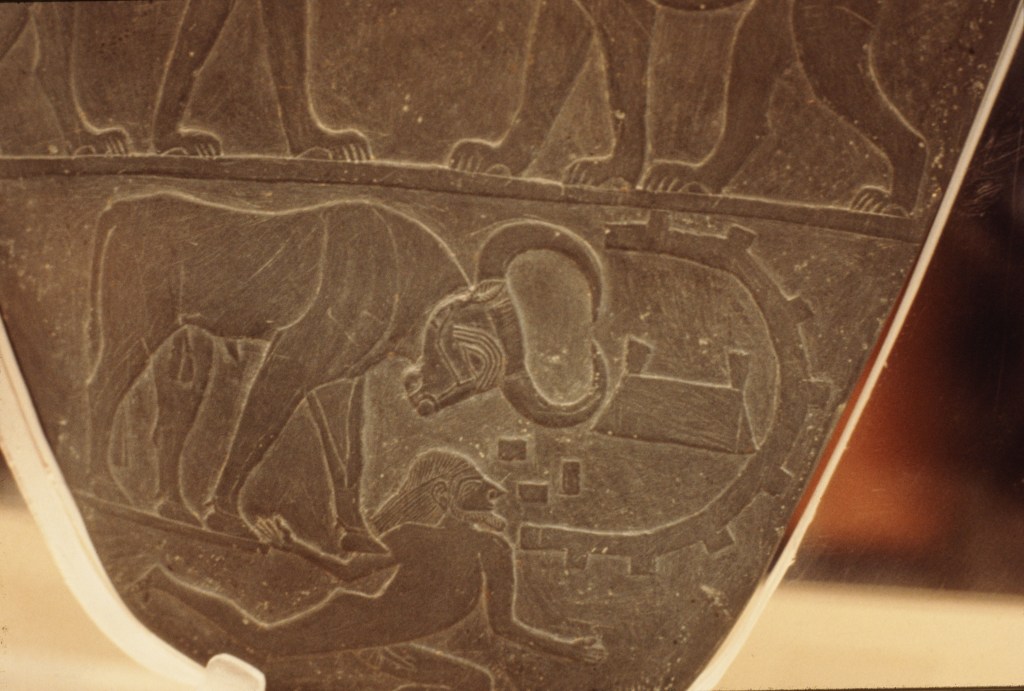
Large bull on bottom of the reverse side of the palette suggests victory, another ? (Walters 1992).

Narmer on the reverse side with crown of Lower Egypt and his name before his face (Walters 1992)
The top of each side of the palette has a frontal face with horns and ears. This blending human with cow might be an early Hathor. Hence, the gods or their avatars may have served the ruler as early as Narmer. Sophistication is evident in the quality and choice of figures and details. We may or may not understand the messages.
Narmer’s Palette was intended for display, upright, hence ceremonial rather than a palette or tray. The excavator Quibell found it in 1897 in the property of the Temple of Horus, Hierakonpolis. On the plan of the temple published in 1902, the palette was near or with a seemingly endless deposit, called the ‘Main Deposit.’ Many early items from the Main Deposit are displayed in several museums, such as the Ashmolean Museum.
The material of the Palette of Narmer is not slate but harder, graywacke. The stone was named Bekhen to ancient Egyptians. It comes a distant quarry in Wadi Hammamat, past Qena towards the Red Sea. This hard stone, microcrystalline, was valued in ancient Egypt for monuments serving generations of pharaohs and chosen by Romans for palaces and the elite.
- James A. Harrell, REPORT ON THE PETROLOGY OF WADI HAMMAMAT BEKHEN-STONE, 2011 revised 2016: http://www.eeescience.utoledo.edu/faculty/harrell/egypt/Quarry_stone_petrography.pdf
- Ahmed Ibrahim Othman, Extraction and Use of Greywacke in Ancient Egypt, July 2017 المجلة العلمية لکلية السياحة و الفنادق جامعة الأسکندرية 14(14 – A):98-123 DOI: 10.21608/thalexu.2017.48774 also https://www.researchgate.net/publication/336041967_Extraction_and_Use_of_Greywacke_in_Ancient_Egypt
Narmer’s palette served as the centerpiece in the center hall in the Egyptian Museum, Tahrir, Cairo. The kind curators explained that it will never leave Egypt as it is a national treasure.
Another unique monument from the Temple of Horus, Hierakonpolis, 1897-99 excavations:
Gold hawk, the god Horus
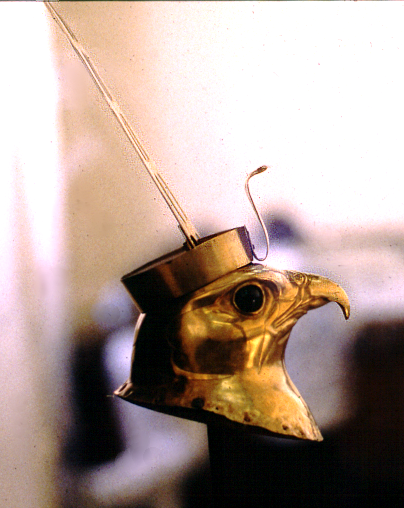
Life sized head of the hawk, gold Horus of Hierakonpolis (Walters 1992)
Gold hawk was found in the center ‘chapel’ in the temple property of Horus of Hierakonpolis. It lay in a container below the floor. Headdress in gold has long been displayed on the head. Copper sheets to cover the body of the hawk conform to the hieroglyph of Horus of Nekhen (top image on this page). The dismantled copper sheets had been the covering for the wood core, original statue of life size. It may have been the cult image for this temple but the date of the temple and the date of the hawk and its changes are open questions.
Conservation by Christian Eckmann, 2006, has placed the gold Horus into the body covering of copper. The majesty of the Gold Horus, just the head, was the monument on display for many years. Obsidian eyes are one piece of stone, one rod spanning the interior of the head, as seen in the Quibell and Green publication. What happened to the original wooden head? The gold head truly is alive and thus far, its part and its excellence defy comparison and secure dating.
 hierakonpolis.com