our website is under construction
Much to share from a place dear in people, containing early town with temple and under the impact from rapid change – regional and local.
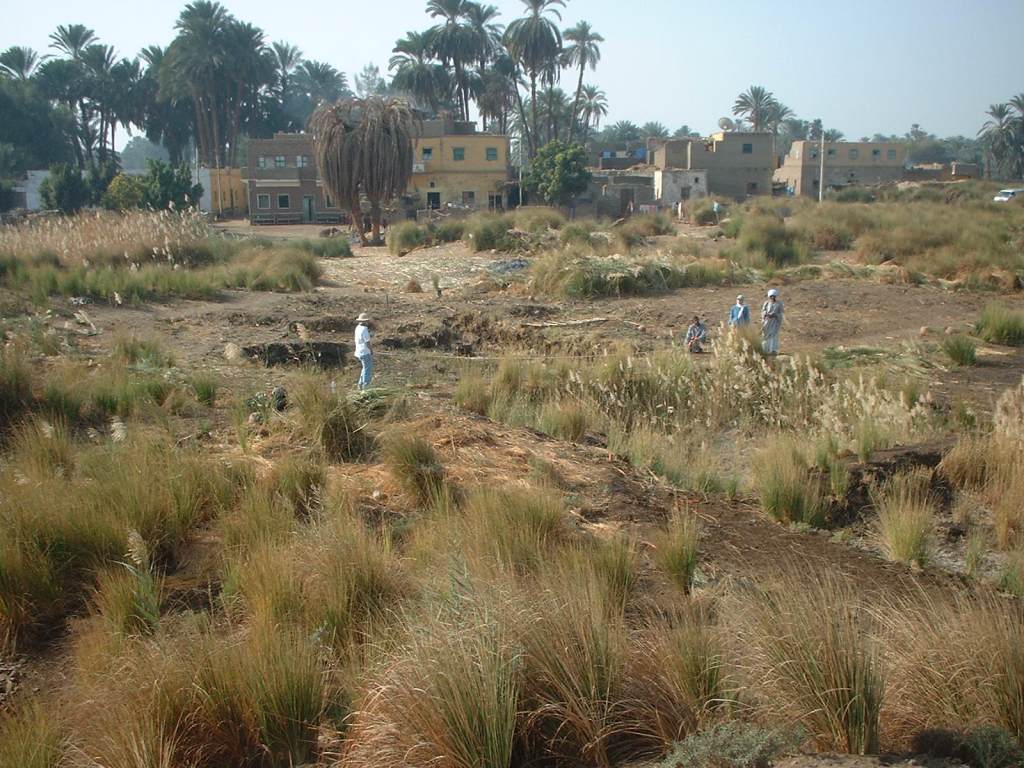
Temple-Town Hierakonpolis (January 2006) view to village across quadrants excavated in 1969. The reeds tolerant of salt occupy surface pools. The surface water in these reed filled pools (on the right) appear and disappear rapidly in January partly with the agricultural cycle of flood irrigation and possibly aided by sand layer found in 1969 excavations by anthropologist Dr. Walter Fairservis. He credited the sand as a construction layer beneath mudbrick walls, in this part of the ancient town.
In 2006 the reeds may seem elegant in my photograph but they are dying, turning yellow. The double date palm (here in the center) is dead from too much salt in the groundwater and the rising groundwater. I remember these date palms as short trees in 1978. They stood as a natural limit to the 1978 fieldwork of Dr. Fairservis. In that year, he succeeded in connecting his excavations to specific structures in the ancient temple, known from first published excavations, 1897-99, Quibell and Green.
Our geoarchaeological project, Temple-Town Hierakonpolis 1999-present studies this important ancient temple and town in its region. Recent rising groundwater and accumulation of salts impact the site, villages and farmland.

This is paradise when all functions as in 1978.
Elizabeth Walters’ photo from the desert edge and road back to the site marked by tall date palms in the distance on the far right.
 hierakonpolis.com
Leave a reply to Elizabeth Cancel reply